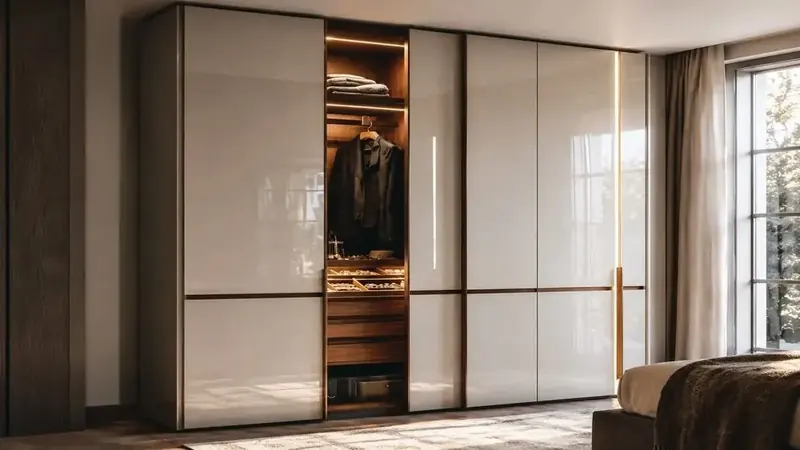
Wardrobe choice usually comes down to one constraint: how much floor clearance your bedroom actually has in front of it. Here's how the three main formats compare.
Swing wardrobe
The classic hinged-door format. Swing wardrobes are generally the most cost-effective option and give full, unobstructed access to the entire interior when open. The trade-off is that open doors need floor clearance in front of the wardrobe — usually at least 2.5 to 3 feet — which can be a constraint in smaller bedrooms.
Sliding wardrobe
Doors slide horizontally along a track instead of swinging open, using almost no extra floor clearance. This makes sliding wardrobes the practical choice for compact bedrooms, especially in 2BHK flats where every square foot near the bed matters. The trade-off is that you can only access one section at a time, since one door always covers part of the wardrobe.
Walk-in wardrobe / closet
A dedicated small room or defined nook lined with storage on two or three sides, entered directly rather than opened like a cabinet. This is the most luxurious and organized option, giving full visibility of your entire wardrobe at once — but it requires a genuinely spare room or a large bedroom corner to dedicate, which rules it out for most standard-sized apartments.
Which one fits your bedroom?
- Compact 1BHK/2BHK bedroom: Sliding wardrobe — saves floor clearance without sacrificing storage capacity.
- Medium bedroom with reasonable clearance: Swing wardrobe — full access at a lower cost per running foot.
- Large master bedroom or a spare nook: Walk-in wardrobe — the most organized, boutique-style option if space allows.
A practical note on cost
Sliding wardrobes generally cost more per running foot than swing wardrobes because of the track hardware and heavier panel construction — but the floor space they save can matter more than the price difference in a smaller room. We measure your exact bedroom clearance during the site visit and show you both formats in 3D before you decide.